
Mack Australia Right Hand Drive Operator Manual
2010 and 2012 Mack Australia Right Hand Drive Operator Manual CMM, CMH, CLX, CXX, CSM
Your new MACK truck contains many new technological advancements that may require new servicing techniques and methods. An authorized MACK truck dealer is in the best position to provide technicians who have the necessary training, experience and tools to properly service your truck.
Thank you for buying a MACK vehicle. With proper care and maintenance, your new MACK will help you gain a competitive edge with its fuel-efficient drivetrain combinations, low maintenance, extended service intervals and, eventually, good resale value.
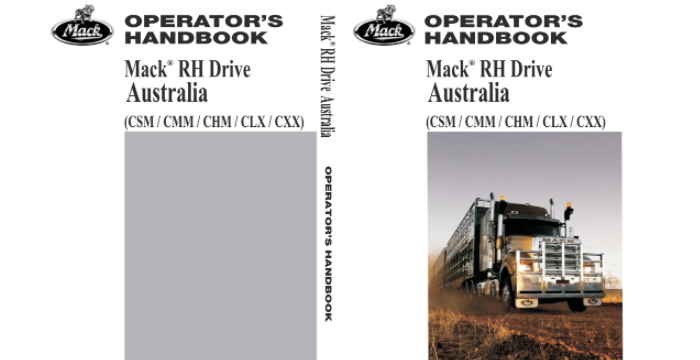
This handbook is referred to as the MACK Right-Hand Drive Series (MetroLiner, Granite, Trident, SuperLiner, Titan) Operator's Handbook. Its identification number is 21847026. Keep this handbook with the vehicle at all times to ensure that each owner and/or operator will have access to all pertinent information relating to the operation and handling of this vehicle.
Engine Identification
On MACK MP engines, the engine serial number is stamped on the left side of the engine block, below the inlet manifold.

In compliance with the emissions standards requirements, an engine exhaust emissions control sticker is affixed to one of the engine valve covers for all MACK engines. This sticker provides basic engine identification information. The engine information sticker is found on the top of the front cylinder head cover on MACK MP engines.
Questions and Complaints
Your satisfaction is our most important concern. If questions or complaints arise, first discuss the matter with the service manager at the MACK facility involved. If you are not satisfied with the service manager's response, contact the branch manager, principal or general manager of the distributorship. If assistance is required at a service dealer, contact the owner of the establishment.
If, for any reason, you need further assistance after dealing with the personnel at a MACK subsidiary or distributor, contact the regional service manager at the nearest MACK regional service office. The regional service manager has the responsibility and the authority to recommend action in most cases and (with the aid of relevant district service personnel) will make every effort to conduct a fair review of the situation.
Seat Belt Operation
MACK vehicles are equipped with locking retractable seat belts. For all seating positions in your MACK vehicle, this type of seat belt is a combination lap and shoulder belt. This type of belt is designed to lock (prevent belt travel out of the retractor) only during sudden stops or impacts. This feature allows the operator to move freely under normal conditions.
Fastening Seat Belt
- Pull clip so the belt crosses your shoulder and lap and insert it into the buckle until an audible snap is heard.
- Make sure the clip is securely fastened into the buckle.
- To tighten the lap portion of the combination belt, pull upward on the shoulder portion until the lap portion fits snugly. The belt should rest as low on your hips as possible.
Panel Arrangement
Your view from the driver seat should look something like the illustrations shown. The layout is designed to provide the operator with a good view of the gauges and controls (which are placed so they are within easy reach). The instrument panel, as shown in the following drawing, is broken down into several main sections. For easy identification we refer to them as Panels A, B, C, D, E and F (where necessary).
Note: This section shows the instruments and controls available for this vehicle at the time of publication. However, depending on options, your vehicle may not have all the instruments and controls shown here, and they may not be in the same position.
Secondary Air Pressure Gauge
Indicates the air pressure in the secondary air brake system. Secondary air pressure is supplied to the steering axle brakes.The normal operating air pressure is between 759 kPa (110 psi) and 897 kPa (130 psi). If pressure drops below 517 kPa (75 psi) ±34 (± 5 psi), the warning buzzer and warning light will go on. Determine the cause of failure before proceeding.
Related Manual
MACK Trucks Service Manuals, Fault Codes and Wiring Diagrams
2010 US Titan by Mack (TD700 Series) Operator's Manual
2010 US Mack Granite Series (GU Series) Operator's Manual
2010 Mack TerraPro Series (LEU Series) Operator's Manual